ICMC: paper and performance

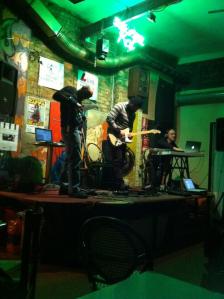
I will be at ICMC12 in Ljubljana on 11-12 sept 12. I will present with Dario Sanfilippo the paper “Towards a typology of feedback systems”. The paper has received the Best Paper Award. Yai! Honored and proud. We will also present a paper + performance “Heterogenously-coupled feedback systems”, of course concerning the Bar Dot Project. We will present the Dark Store setting.

Bar Dot rec session in Turin

Pseudo at Grec Festival, BCN, 24-26/07/12

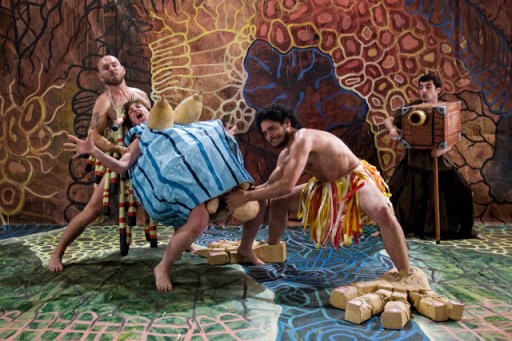
I’m proudly presenting Marcel·lí Antúnez Roca‘s new work Pseudo, to be premiered on Thu 24 July at Mercat de les Flors for the Grec Festival, in Barcelona. An impressive mechatronic peformance featuring a polar bear, a mechanical head, a miniprojector helmet, loudspeaker tits, 3 screens, a guncam, four channel audio, of course interactive and in real time, ‎(not to speak of pressure carpets and the usual exoskeleton). I made some 20 pieces, interactive, working in real time, on four channels, and developed the software structure for interconnecting the music application to the other (many) software components used in the performance. Of course, entirely developed in SuperCollider.

Pseudo!
Pseudo!

Hommage to Enore Zaffiri

On March 27/28, together with Stefano Bassanese, we organized a two-day seminar dedicated to Italian pioneer of electronic music Enore Zaffiri. In the occasion, we discussed his opus and dedicated him a concert with electronic and instrumental music. I played my reconstructed version of Zaffiri’ 1968 masterpiece “Musica per un anno” on four channels. Some shots here.

Musica per un anno, SuperCollider sw interface

Rumentario autoedule

I’ve added on Vimeo a short video of the “Rumentario autoedule” installed in Como for Elettrosensi 2012.

Rumentario autoedule

In the “Rumentario autoedule” installation the Rumentarium electro-mechanical ensemble, made up of 24 acoustic generators, is coupled with audio analysis capabilities. Two mics capture the surrounding soundscape.
Retrieved pitch and loudness profiles are used to drive the orchestra. As the soundscape around is mostly (even if not only) made up of the same rumentarium, the latter reacts to itself.